

When the remains of Richard III were found in 2012, it was discovered that he had sustained several injuries during the Battle of Bosworth, where he fought for his crown.

On examination, Richard's skull presented several wounds, two of which were massive. The first wound examined is consistent with a halberd being used. The second was a jagged hole where a bladed weapon had been thrust right through the bone, resulting in an indentation, showing that the blade had penetrated the king’s head to a depth of 10.5cm.
Both injuries would have ended the king’s life, but which came first, and what does history tell us?
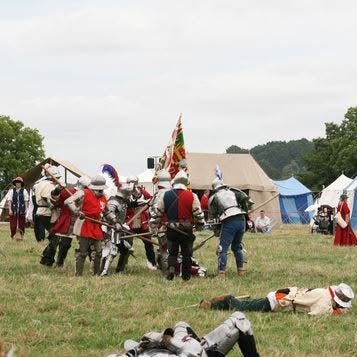
Legend has it that the fatal blow was struck by Welshman Rhys ap Thomas, a man once allied to the Yorkist party who traitorously changed his allegiance. With one thrust of his halberd, it has been said,1 he took the life of the king who was the last monarch to die in battle.
Of course, we can never know who struck that last blow, but one intriguing piece of evidence points to the fact that Rhys ap Thomas may have been Richard's nemesis, and very proud he was of it too!

The medieval bed is associated with wealth and the social standing of its owner; one such bed shows this quite clearly and now stands in Rhys ap Thomas's room at Derwydd House in Llandybie, Carmarthenshire.
Made out of Welsh oak, only the three valances are considered to be from the original bed. One of these side valances may prove that the Rhys ap Thomas legend is true and that this treacherous Welshman did indeed strike the fatal blow against Richard. A scene carved into the wood depicts two mounted knights facing one another; between them stands a soldier with a halberd; it is this soldier that is thought to be Rhys Ap Thomas.
The bed is dated to about 1505, the same time that Henry VII appointed the Welshman to his privy council and made him a Knight of the Garter.
There's no better way to boast how you climbed the ladder of success (never mind that you let the victor of Bosworth walk all over you)2 than carving your greatest achievement on your most prized possession.

Rhys ap Thomas is said to have been "a man of integrity and honour ", and that, of course, is a matter of opinion.
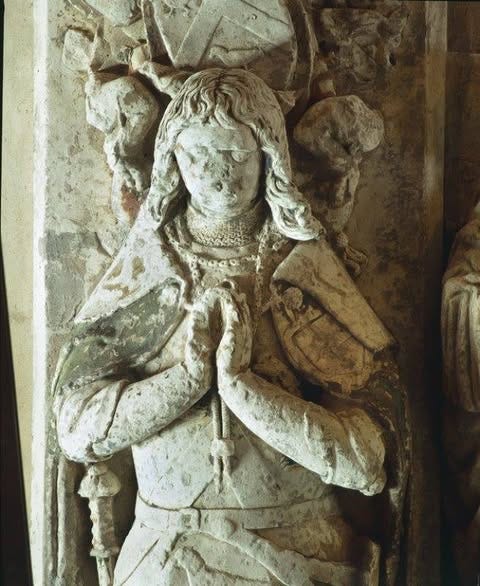
It has also been suggested that the larger soldier behind the mounted knight is Rhys ap Thomas; however, either of these men could depict this Welshman. The weapons they are wielding would have caused the fatal injuries that resulted in the death of King Richard III. Of course, which one it was depends on how this Welshman saw himself, not necessarily the weapon he used. If Rhys ap Thomas saw himself as the man who brought an end to the Plantagenet dynasty and was responsible for kick-starting the Tudor dynasty, then he may choose to place himself between the two main players, or he may wish to have himself seen as a mighty poleaxe-wielding hero, which Welsh poets like to write so much about.
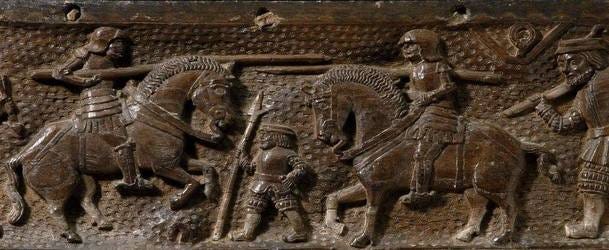
Whatever way Rhys ap Thomas chose to boast of his exploits, or whichever weapon he used, I think that we can say that this legend is possibly true.
Welsh poet Guto’r Glyn - ‘avoids specifying who was responsible for killing him on the battlefield at Bosworth, but this passage suggests that he was killed by a troop of soldiers led by Rhys ap Thomas.’ and Chroniques de Jean Molinet (1474-1506)
“Whoever ill-affected to the state, shall dare to land in those parts of Wales where I have any employment under your majesty, must resolve with himself to make his entrance and irruption over my belly.” Oath made to Richard III. The Bishop of St David’s advised Thomas to take the oath literally in order to not be bound by it. It was suggested that Rhys should ‘lie on the floor and allow Henry Tudor to step over his body. He decided to stand under the Mullock Bridge while Henry and his army marched over it, thus fulfilling the oath.’